It’s the fifth article in the ‘Core Skills’ series, where I return to the essential riding foundations and rebuild them from the ground up in a fresh way, using a brand-new structure too. Today we move from essential control skills to looking at interactions with other road users. It’s time for a Fresh Start look at junctions and intersections.
#freshstart, #coreskills
THE MYTH — “If the driver had looked properly, this wouldn’t have happened — there was nothing I could do.”
Wherever motorcycles share the road with other vehicles in urban areas, collisions occur. And the driver so often apologises for not having seen the motorcycle — “Sorry Mate, I Didn’t See You” — that the term SMIDSY has become the popular name for the junction collision between a motorcycle and another vehicle — usually a car.
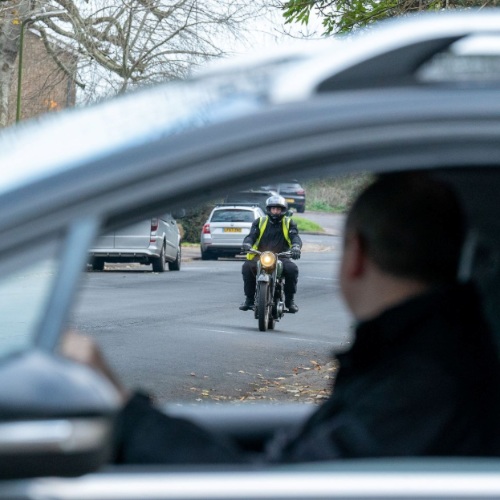
And “Sorry Mate…” has become the de facto explanation for the SMIDSY — since road safety takes the simple view that if a driver “looked properly” for the motorcycle, it would be seen. From that, an equally simple conclusion is drawn — if the motorcycle isn’t seen, the answer is ‘obviously’ the driver must have “failed to look properly”. Not surprisingly, the SMIDSY collision has become almost synonymous with careless driving. Riders hear drivers “failed to look properly” in police accident statements, they hear it from the motorcycle press, they hear it from instructors, and — most frequently of the lot — they hear it from other riders themselves.
And so half-a-century of campaigns have told drivers to “Think BIKE!”, to “look twice”, and to “look harder / longer / twice” for motorcycles.
What’s changed? Not much. Despite five decades of this advice, junction collisions remain the single most common crash between motorcycles and other vehicles in the UK. Drivers appear to be no better at seeing modern motorcycles, and riders are no better at avoiding the consequences of the SMIDSY error than they all were several generations ago.
It’s this very failure of the Think BIKE! campaigns that should make us look harder at the underlying assumption that most SMIDSYs are caused by drivers who “failed to look properly”.
THE MECHANISM — “How the SMIDSY actually develops.”
Once we start to ask questions, it’s easy to turn up hundreds, probably thousands, of research studies into the SMIDSY, dating from the 1960s right up to the current day, ranging from simple lab experiments to complex in-depth investigations into real-world crashes. And this research consistently shows that the majority arise from entirely human limitations; in vision and perception, in judgment and attention.
In short, drivers are human and humans are prone to errors.
Understanding the driver’s likely error then becomes valuable because it helps predict how a SMIDSY moment might develop. There are three main ways the driver gets it wrong.
1. Looked But COULD NOT See: Sometimes the motorcycle is physically obstructed from view. Hedges and tree trunks, telegraph poles and roadside clutter, parked vehicles and pedestrians, and particularly the driver’s A-pillars either side of the windscreen all create ‘Zones of Invisibility’, areas into which the driver cannot see no matter how ‘hard’ and how long and carefully they look. Riders often see the car, but forget that the car isn’t (yet) equipped with eyes. If the motorcycle lies inside one of those zones at the precise moment the driver checks, the rider is out of sight, and probably out of mind too. And if the angles and movement line up, what’s known as the ‘Constant Bearing, Decreasing Range’ phenomenon means that a bike on a collision course stays hidden behind the A-pillar as both vehicles move, making it physically impossible for the driver to see the motorcycle until the last second.
2. Looked But FAILED To See: This is the classic “driver looked but didn’t see the bike” error. The motorcycle is technically visible, yet thanks to a human visual perception failure, the driver fails to consciously register it. Human vision is highly selective. Only a tiny central area provides detailed focus and ‘object identification’. The human eye is weak at detecting objects approaching directly towards it because there is no lateral movement across the driver’s retina — the phenomenon of motion camouflage. The motorcycle doesn’t ‘break’ the background, making it incredibly difficult to detect until it gets close, begins to rapidly expand across the background and suddenly ‘pops’ into the driver’s awareness. This is known as ‘looming’ and detection is usually too late for the driver to react. When we turn our heads to look both ways, our vision shuts down — saccadic masking — meaning a driver believes they have checked and the road is clear but the motorcycle is undetected. And in complex traffic situations, not only is the driver looking in several directions and trying to process the movement of a number of different vehicles, there may be too many objects for the brain to process and the driver focuses on finding a ‘car-sized’ gap to the exclusion of other objects. This is ‘Inattentional Blindness’ and it’s nothing to do with ‘inattention’ but too much attention given to one task — the search for that gap. Other objects go undetected. Whilst it’s often the motorcycle, drivers pull out in front of other cars, even trucks and buses.
3. Looked, Saw, But MISJUDGED: Sometimes the driver genuinely sees the motorcycle — but incorrectly judges its speed or distance because motorcycles also produce poor visual expansion cues. Having seen the motorcycle, the driver believes there is more time to complete the manoeuvre than is really available.
Once riders understand these three failure modes, junction collisions stop being mysterious. They stop being accidents of fate and start being predictable events we can get ahead of.
THE MISTAKE — “Why riders don’t avoid an ‘avoidable’ collision — leaving it to the driver.”
A significant problem is the framing of the SMIDSY as a one‑sided ‘driver error’ which imposes responsibility for preventing the collision to the driver — regardless of the fact that it’s the rider that suffers for the driver error, there’s little attempt to prepare the rider to cope when the error happens. This is made worse when advice to “Ride Bright” — to switch on headlights and wear hi-vis kit — is equated with “the need to be seen ”. In reality, hi-vis clothing and DRLs may help in some situations such as low light and poor visibility conditions, but riders often treat them as definitive protective measures thanks to messages suggesting conspicuity aids make motorcyclists “more visible”. There’s little compelling evidence to support that claim, not least because conspicuity aids require the motorcycle to be visible, and that’s not always the case. In the run up to a significant number of SMIDSY collisions, the real issue was “Sorry Mate… you weren’t riding where I could see you!”
I’ve also heard it suggested that the SMIDSY collision is “too complex for the rider to predict what will happen.” In reality, from the rider’s perspective — and that’s the one that really matters to us — a SMIDSY is a simple binary problem:
1. the vehicle turns in front of the motorcycle.
2. the vehicle doesn’t.
It really is as simple as that. And the final problem for the rider is to recognise that there are TWO manoeuvres possible at an intersection:
1. the vehicle EMERGES from the rider’s nearside.
2. the vehicle approaches from the opposite direction and TURNS TO the riders nearside.
The latter possibility is almost entirely off the average rider’s radar, yet appears to be more deadly than the classic ‘car pulls out’ collision. Having identified a vehicle capable of crossing their path, the rider faces a simple problem:
“Can I take evasive action if that vehicle turns into my path?”
Asking that question determines whether the rider approaches the junction in a prepared or unprepared state. The rider doesn’t need to guess the driver’s mind, just to prepare for the Worst Case Scenario. It’s a mistake to treat the SMIDSY as something unpredictable rather than a recognisable pattern.
Here’s the bad news. A consistent finding across collision studies is that many of these crashes at junctions were avoidable — if the rider had:
1. Recognised the risk developing.
2. Responded in time.
———————————
IF YOU THINK THIS POST HIT THE SPOT
please pay it forward to other bikers!
Like ✔ Comment ✔ Share ✔ Follow ✔
ANSWERING QUESTIONS NO-ONE ELSE ASKS
FIND OUT how you can get Survival Skills!
👉 visit us at www.survivalskills.co.uk
👉 discover the Eight Week eCourse at
our NEW website: www.motoonline.co.uk
For all the links use the Link-in-bio page
👉 https://campsite.bio/survivalskills
———————————
THE METHOD — “Adopt a proactive survival strategy at junctions.”
The first step is identifying potential conflict points early. We need to pro-actively search for:
-
-
- Road markings and road signs.
- Side roads and waiting vehicles.
- Concealed openings, gateways, gaps in hedges.
-
Any location where vehicle paths may intersect deserves our full attention. Reducing speed early creates the extra time margin needed to fully scan our environment and also improves braking distance and escape opportunities should they be needed. Rolling off before junctions may feel frustrating, but it massively increases survival odds.
The second step is to assess our own view; “what we can see” and is in clear view, and “what we can’t see” and is hidden. What we have to avoid is falling into the ‘out of sight, out of mind trap’ and the easy way to do this is not to try to guess what’s concealed but to actively search for ‘Vision Blockers’ that obstruct our view and might be hiding openings and junctions behind them; hedges, buildings, parked cars and so on.
Third, having spotted a vehicle that could emerge, assess what a turning driver can and can’t see. Check for lines-of-sight and remember that the driver’s view of your bike is likely to be far worse than your view of their vehicle. Look for Vision Blockers like poles, trees or even the pillars supporting the vehicle’s windows. Road position matters here. Sometimes moving slightly within the lane opens sight lines earlier.
Fourthly, assess the driver’s workload. Is it only your bike that the driver has to see? Or is the road busy, with multiple ‘targets’ moving in different directions at different speeds? Being the only vehicle doesn’t guarantee we’ll be seen, but it becomes relatively more likely we might not be seen when the driver is tracking a number of vehicles. Is our approach speed high, and does that make the ‘misjudged speed and distance’ error more likely?
Fifth, look for clues that the driver hasn’t seen us, such as edging forward, looking the wrong way, and — a crucial warning sign that I’ve learned from experience — a sudden ‘double-check’ where the driver looks both ways very rapidly at the same time as a shift of hand position on the steering wheel. I’ve learned this is usually the driver’s final check, and the change of hand position comes after they have decided it’s safe to emerge. This final double-check is often too rapid to be useful. It’s usually recommended that we watch for movement of the front wheels of the vehicle, that can be too late if the car moves suddenly. Watching the driver gives us just a fraction more warning.
And that leads to the sixth step; do something about it. If in any doubt, start by sounding the horn. That’s something often forgotten until too late. It may not stop the driver, so be ready to brake hard or swerve. The goal is not necessarily to stop, but to retain the ability to stop if the emergency develops. And don’t accelerate except to clear of the ‘Killing Zone’ where the collision would occur.
These small preparations are often the difference between a near miss and an ambulance ride.
THE MINDSET — “From blame to survival.”
Moving from believing “the driver should have seen me if they’d looked” and “there was nothing I could have done” requires reframing the SMIDSY as a predictable and manageable situation where we can look after our own survival by becoming an ‘active manager’ of risk. It represents a switch of understanding to recognising the SMIDSY as a shared ‘human factors’ problem where drivers are prone to errors and the motorcyclist needs to respond to a ‘dynamic’ hazard with a threat level that can change in an instant. Junctions are not simple static hazards just because the junction itself doesn’t move and the collision itself only becomes a reality if the motorcyclist rides into it.
That’s why I refer to the SMIDSY as a ‘Two to Tangle’ crash. This is not victim-blaming. It is recognising reality. This does not mean panicking at every junction. It means recognising a junction as an active problem-solving exercise. This is not paranoia. This is informed caution. This is understanding that avoiding the collision matters far more than winning the legal argument afterwards.
It really doesn’t matter who got it wrong, since priority at a junction is not a physical force field, and there is no retrospective injury protection from being legally correct.
THE MARGIN — “Smart riding isn’t luck.”
So much in motorcycle safety comes down to recognise that riders who avoid the standard ‘gotchas’ like the SMIDSY collision do not rely on luck. Nor is it simply riding technique. It’s about understanding how, where and why these crashes actually happen, then exploiting the knowledge to recognise the tell-tale patterns early enough to take decisive action if it’s needed. That’s the way to avoid being the final domino in someone else’s mistake. The key principle is simple:
If a vehicle CAN go, one day it WILL go.
===================
WANT A FULLY-STRUCTURED BOOK ON ADVANCED RIDING?
WRITTEN BY A QUALIFIED & EXPERIENCED RIDER COACH?
CHECK OUT ‘Survival SKILLS’ – the guide to advanced riding that doesn’t tell what to do but helps you develop your skills In your own time, at your own pace, anywhere in the world!
ORDER THE PAPERBACK:
http://lulu.com/spotlight/SurvivalSkills
INSTANT eBOOK DOWNLOAD:
https://ko-fi.com/s/2362ab146d
===================