Fresh Start from Survival Skills | Steering Core Skills
In this second in a new series, I return to the essential riding foundations and rebuild them from the ground up in a fresh way, using a brand-new structure too. Today it’s time for a Fresh Start look at steering.
#freshstart, #coreskills
THE MYTH — “The bike turns because you lean your body in to the corner.”
This “steering by body-leaning” is probably the oldest and most persistent misunderstanding in motorcycling. The problem is that it conflates three distinct elements that sit under what we loosely call “steering”:
1. For a motorcycle to follow a curved path, the bike and rider — as a combined mass — must lean away from the vertical. Without that lean, the bike will not change direction.
2. Lean angle doesn’t appear by magic, and it isn’t created by the rider “leaning in”. At road speeds, the effective way to initiate lean is by applying a steering input at the bars — counter-steering. This is the controlled method of creating that lean.
3. We can move our body but this is not the main steering mechanism, and in fact, to make the bike lean using body weight alone, we would have to move our mass slightly outwards, shifting the combined Centre of Mass so the bike tips the other way. This is a simple consequence of basic Newtonian Physics. To make a bike lean in one direction with body weight alone, we have to move our body in the other direction. With a low ratio of rider weight to machine weight, it is slow, indirect, and imprecise.
Every rider who rides on the road is already doing this. Virtually every change of direction, and certainly every controlled change of direction, involves counter-steering — whether we realise it or not.
One reason the myth persists is that the real mechanism — counter-steering — feels counterintuitive. Riders understandably question the idea that to turn left, the front wheel must briefly be steered to the right. A second factor is how it has been taught. In the UK, counter-steering has often been treated as “too complicated” for new riders, and for many years it was not consistently emphasised in basic training. Even now, coverage is variable: some schools explain it clearly, others barely mention it.
While “leaning in” by shifting weight to the inside of the turn is not what initiates the turn, it is a legitimate technique for adjusting the lean angle or maintaining ground clearance once the turn is established.
Perhaps it’s not surprising that many riders pass their test still believing they “lean in” to make the bike change direction — despite the fact that, in practice, they are counter-steering every time they do so.
THE MECHANISM — “Input → roll → direction change”
To follow a curved path, a two-wheeler must lean. This requires the bike and rider, as a combined mass, to balance gravity with the inward force required to change direction. If speed or turn radius changes, the required lean angle also changes.
The rider applies steering inputs that create roll; roll brings the bike to a lean angle; and that lean angle determines the turn radius. If speed or radius changes, the matching lean angle changes too.
In other words, lean does not appear on its own — we have to create it. That’s the role of counter-steering. We briefly steer the front wheel away from the intended direction. Say we want to turn left. We push the left handlebar.
i. Push left → front wheel momentarily points right
ii. The contact patch moves out from under the centre of mass
iii. Because of inertia, the bike and rider’s combined Centre of Mass doesn’t move right with the wheel; it tries to stay on its original path (Newton’s First Law). This effectively “trips” the bike, forcing it to tip (roll) to the left
iv. The bike falls (rolls) to the left
v. Once the desired lean is reached, the wheel naturally realigns to points slightly into the turn to maintain stability, thanks to the bike’s geometry
This is counter-steering.
Some explanations of counter-steering state that it is the result of gyroscopic precession. While spinning wheels contribute stability and a small amount of roll torque when steered (and an engineer called Tony Foale directly measured this decades ago), the primary force initiating the lean is the lateral movement of the contact patch where it touches the road surface. Gyroscopic forces are secondary to tyre contact patch displacement and in fact it’s been shown (by building bikes with a counter-rotating mass to cancel out the front wheel’s gyroscopic forces) that a two-wheeler can be steered without them.
Our input at the bars directly controls the roll:
i. How quickly the bike leans → rate of roll (how fast direction changes)
ii. How far the bike leans → resulting change in direction
We can also change the way we push the bars:
i. A firmer push = faster roll
ii. A longer push = greater lean angle
Once the desired lean is reached, we reduce steering input and the bike stabilises into its new path. By maintaining a light, continuous pressure on the inside bar we keep the bike in a stable curved path. This is needed to balances the natural tendency of the steering to self-right the bike to the upright position.
When we want the machine to return to an upright condition, we remove steering input. At typical road speeds, the motorcycle’s inherent dynamic stability — driven by steering geometry, tyre forces, and forward motion — will tend to bring it back towards an upright running state once lean is no longer being sustained.
This stabilising behaviour generally becomes stronger with speed. At very low speeds, however, that stability reduces significantly and may become insufficient to maintain balance on its own. To stay upright, we must make small, frequent steering inputs to keep the machine upright and prevent it toppling.
We also need to keep an eye on our ‘Grip Budget’. It’s important to remember that tyres have a finite amount of grip shared between three forces: acceleration, braking, and cornering. If we are braking or accelerating hard, there’s little grip left for steering, and poor surfaces may offer little grip for all three. Traction will be covered in detail in another article, but for the moment remember that to make a decisive steering inputs, we must ensure the front tyre has sufficient grip to change the bike’s direction.
———————————
IF YOU THINK THIS POST HIT THE SPOT
please pay it forward to other bikers!
Like ✔ Comment ✔ Share ✔ Follow ✔ANSWERING QUESTIONS NO-ONE ELSE ASKS
FIND OUT how you can get Survival Skills!👉 visit us at www.survivalskills.co.uk
👉 discover the Eight Week eCourse at
our NEW website: www.motoonline.co.ukFor all the links use the Link-in-bio page
👉 https://campsite.bio/survivalskills
———————————
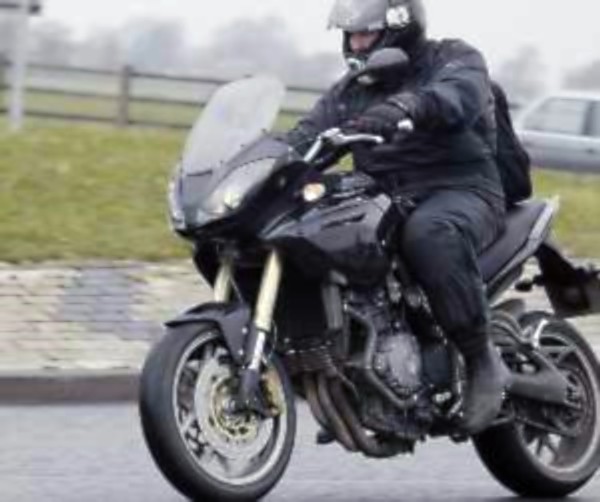
THE MISTAKE — “Straight arms, tight grip.”
Many riders understand the “push to turn” principle of counter-steering, yet still struggle to make the machine change direction smoothly or predictably. The issue is often not for a lack of trying but how effectively that input is transmitted into the handlebars. A common reason riders struggle to steer is that they are unknowingly leaning on the bars. Steering input must be applied to rotate the handlebars around the steering axis. This requires a more-or-less horizontal push.
This is where posture plays a critical role.
1. On bikes with low handlebars, it is easy to end up supporting body weight through the bars. In this position, instead of pushing the bars forwards, the rider tends to push downward. This is why many road bikes position the bars roughly around elbow height — it allows the rider to apply push-steering without supporting their mass on the steering mechanism.
2. Riding with stiff arms mean that as hard as we push one end of the handlebar, our opposite arm tends to resists that pressure. By locking our arms, we turn our upper body into a rigid frame that resists the very movement we’re trying to initiate making it very hard to turn the bars swiftly or smoothly. Think of the elbows as pivot points, allowing the arms to move like a pair of opposed pistons — one in, the other out.
3. Once the bike ‘sets’ into the corner, the front wheel will naturally begin to swing round to point into the turn. If we’re stiff-arming the bars, we resist this movement which makes it difficult to steer accurately.
Here are two ways to test posture while riding:
i. Do the ‘Funky Chicken’: Pe
riodically check if you can ‘flap’ your elbows like a bird. If they’re locked, you’re likely supporting your weight with your arms rather than your core.
ii. Look for the white-knuckle ‘Death Grip’: if you’re clenching your fingers all the way around the grip, that alone makes it difficult to let the bars move, and dulls the “feel” for what the front tyre is doing.
The fix is to adopt the correct posture to ‘free’ the steering:
i. Slight bend in the elbows
ii. Relaxed shoulders
iii. Light grip on the bars
iv. Weight supported by core and legs
This allows our input to go into the bike, not into our own body. It’s also worth noting that counter-steering is not exclusively a “push” action. We can just as effectively create the same steering torque by “pulling” on the opposite bar, or by combining a push on one side with a pull on the other. In all cases, the key mechanism is the same: we are applying a rotational force to the steering assembly, which initiates roll and produces the direction change.
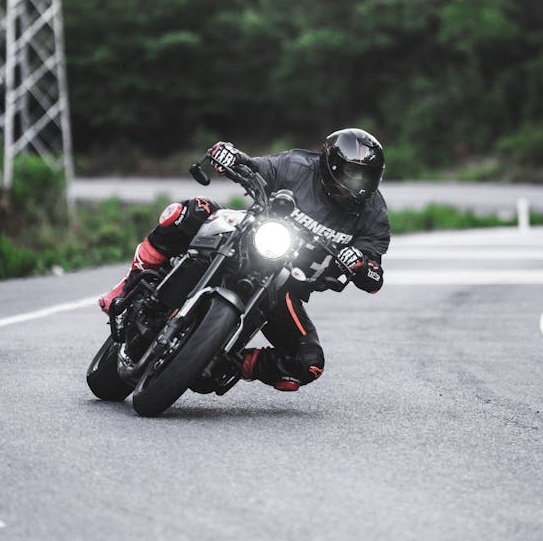
THE METHOD — “Steer out to fall in.”
At ordinary road speeds, only light pressure on the bars is needed to change direction. At higher speeds, or when a rapid change of direction is required (such as an emergency swerve), a firmer and more decisive steering input may be necessary to generate the required rate of roll.
Set posture; relaxed shoulders, flexible elbows, light hands, supporting weight with legs and core. Remembering — and quietly repeating as we ride — these eight words can help anchor effective steering: “Push left, go left. Push right, go right”. This simple expression reduces steering to something we actually do, by applying a light, progressive steering input to initiate roll.
Lightly push the i
nside bar forward, not down. The bike will drop smoothly into the lean — the important factor is the creation of a steady steering torque at the bars, making the bike roll predictably, and direction changes smooth and repeatable.
Remember, counter-steering is a transient action and once the desired lean angle is reached, relax the pressure. If you continue to push, the bike will continue to lean further.
The easiest way to practise is in an empty car park, where a simple steering drill at around 20 to 25 mph allows us to focus purely on getting use to feeling how steering input causes the resulting change in direction.
Critical Safety Note: Don’t accelerate or brake during the steering manoeuvres. Make sure there is plenty of space at either end to speed up and slow down. Allow adequate space around you too, in case steering doesn’t go as smoothly as planned initially.
Relax your wrists, elbows and shoulders, look where you want to go, then give the left bar a light forward press and feel the bike fall left. Repeat on the right. Remember that as the bike ‘sets’ into the corner, the front wheel will naturally point into the turn. Don’t try to force it. Start with gentle inputs and within a few minutes you’ll be able to ride a smooth left–right slalom. Practise until the push feels normal and repeatable, and the roll becomes smooth and predictable. If it isn’t working, check posture first — don’t push harder.
In an emergency swerve, remember: steer, change direction, then recover by steering upright again. Avoid braking mid-swerve to preserve maximum traction for the turn.
THE MINDSET — “Lean angle is a choice.”
On the road, the steering input is so slight that most riders do it without realising and that’s why some still insist they “dip a shoulder” or “lean into the corner” to make the bike turn. When a rider ‘dips a shoulder’ their arm naturally extends, which creates the forward push on the bar, applying a small, unconscious counter-steering push. They are counter‑steering — just without the awareness or control that comes from understanding it. Once we know what we’re doing, we can choose when and how much to steer, instead of hoping instinct gets it right.
At road speeds, a motorcycle’s gyroscopic stability wants to keep it going straight. Counter-steering is an ‘executive command’ to the bike, keeping the rider in charge, consciously choosing when and at what point to steer. This is why it’s sometimes called “active steering” or “positive steering”. It’s the same thing.
In sudden stress situations, the brain’s instinct is to freeze (and do nothing) or brake hard (which sits the bike up). By shifting mindset to “steering as a choice”, we begin to train ourselves to override the survival instincts and replace them with the conscious choice to steer around a threat.
THE MARGIN — “Steering delivers time, space and corrections.”
Steering is not just about cornering lines — it is the technique whilst allows us to make direction changes, and that may be needed at any moment, not just when we enter a corner or need to change direction to negotiate another hazard, but when we ourselves have made an error or someone else’s manoeuvre has eaten into our safety bubble.
Steering is not just a ‘performance skill’, it’s a basic risk management tool. The ability to steer deliberately — not accidentally — is one of the biggest safety margins we can build into our riding. Control of steering delivers control of direction.
Remember that braking and swerving are best applied as separate actions. Applying heavy front brake while initiating an aggressive swerve can overwhelm the tyre’s traction or cause the bike to ‘stand up’, resisting the turn. Even with cornering ABS, it’s best to think of it as a safety blanket, not a tool for exploiting by braking into bends.
To sum up, counter-steering gives us lean on demand. If we can steer accurately, we are in control. If we can’t, we are a passenger.
SUMMING UP — “This is a ‘core skills’ review”.
This is an overview of steering, a bit more than a ‘steering basics’ primer for new riders, but not a full ‘advanced riding’ treatise and it doesn’t include the situations where we are going to need to steer the bike. The intent is to offer a starting point for a ‘skills reset’ and a way to (re)build the foundations that every rider relies on, from CBT graduates to experienced veterans.
WANT TO KNOW MORE? FOLLOW THE TAG CLOUD
===================
WANT A FULLY-STRUCTURED BOOK ON
ADVANCED RIDING? WRITTEN BY A
QUALIFIED & EXPERIENCED RIDER COACH?
CHECK OUT ‘Survival SKILLS’ – the guide to
advanced riding that doesn’t tell what to do
but helps you develop your skills In your own
time, at your own pace, anywhere in the world!
ORDER THE PAPERBACK:
http://lulu.com/spotlight/SurvivalSkills
INSTANT eBOOK DOWNLOAD:
https://ko-fi.com/s/2362ab146d
===================